We are trying to salvage as many of the materials for our house as we can. It fits with our environmental goals, and it fits with our budget! We’ve written about salvaging our windows before, but we thought it’d be fun to take you along with us on a day of salvaging.
We’ve been to most of the main salvage yards in the Bay Area, and we really like Whole House Building Supply in San Mateo. We were there with Meg last Saturday, then went back with our truck on Tuesday to really spend some time, pick up Meg’s doors and our own purchases, and to film along the way. Whole House has a great selection of lumber, as well as the doors, windows, sinks, and other items we’ve seen in other places. They also have really fair prices, artwork made of salvaged objects, and demolition sales, where you can go to a house they are taking apart and buy things right off of it (we have yet to do that!).
We’ve also visited:
Urban Ore, Berkeley – major “eco-park” with lots of interesting stuff.
Ohmega Salvage, Berkeley – more like an antique store, inspiring but expensive.
And, of course, our home away from home, Maselli’s, Petaluma, where we bought many of our tools, our strong ties, and countless extremely useful odds and ends.
And still on our list is to check out the Sonoma County Dump and Building Resources in San Francisco. Any recommendations for more salvage opportunities in the Bay Area?
We got a great haul from Whole House including flooring, interior siding, odd pieces of finish plywood for shelving, a mirror, a couple of tiles, a few sheets of plywood in good condition, and more.
Check out our video to see inside the salvage yard and to see our purchases!
We sent out a blank post earlier today! Oops. Here’s the real thing!
by Joseph
Hello All. We’ve been cooking along on our tiny house, and have received so much encouragement and physical, emotional and cyber-ical help from y’all. Thanks! We figured it was time for an update on the nuts and bolts of the build.
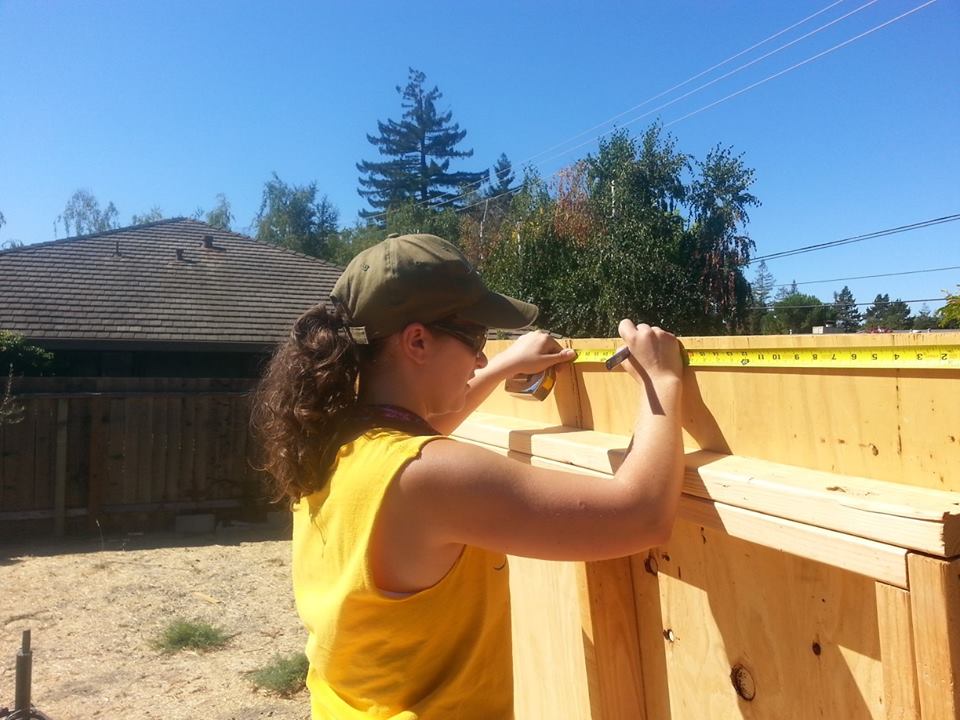
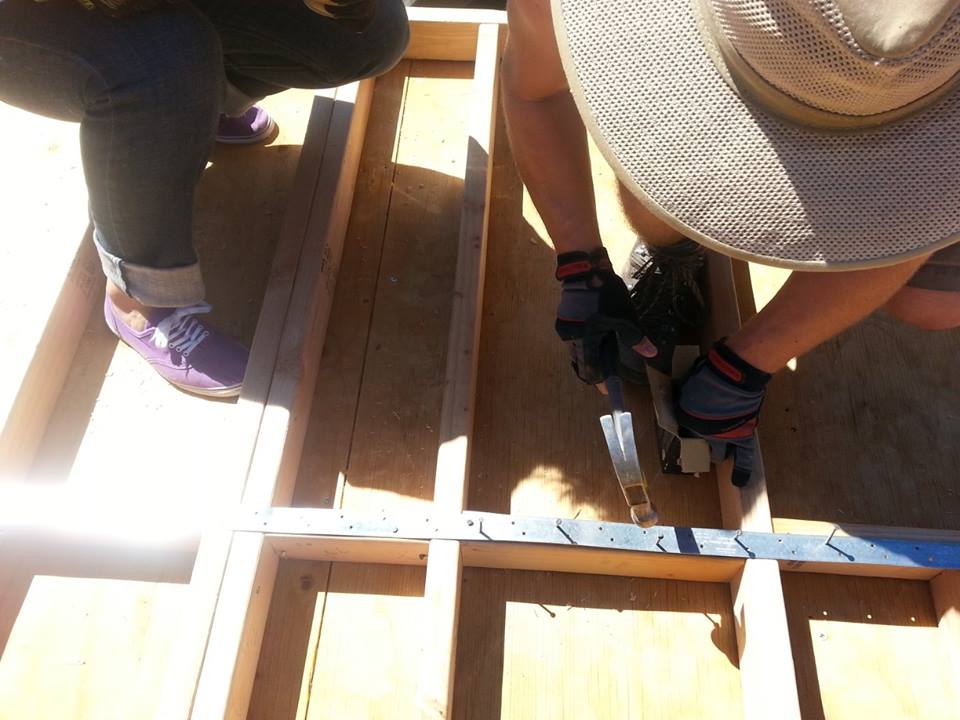
Our second wall is UP! Building this wall went SO much faster than building our first wall, which is about a third as big. Meg and Bre, two of our group build compatriots, helped us measure, nail, and everything else to make this wall happen. We’ve discovered building goes much faster with three or four people than with just us two. Once we had the wall built, we got even more help. Five generous, charming, and strong Tumbleweed staffers joined us to lift the wall’s thousand pound mass up and over the welded-on trailer bolts, and then tilt it carefully into place.
Our new wall is a little out of square, but after letting it sit for a few days it went from one-and-a-half inches out down to three quarters of an inch out… and we think (hope!) once we start strapping and bolting things down it’ll get even more level/plumb.
Here are some pictures of our progress.
base plates in place and pre-drilleda header for the windowSarah measuring and placing things for a dry run.Meg measuringMeasuring X 2tissues = KEY!Joseph and Bre hammering the coil strapmore coil strapThe Tumbleweed staff took a break from the office to lift the wall into placeI have no idea how we would have done it without them!plywood overhang to connect the walls
Team Purple (Bre and Joe) are working on their shou-sugi-ban siding while they wait for their SIPS to be delivered; it is beautiful! Shou-sugi-ban is a traditional Japanese wood treatment. They torch the wood, then sand/wipe it, then treat it. We’ve included some pics here and we’ll definitely share more as they progress.
Meg is making a beautiful butcher block for her interior counter tops using multi-colored strips of hardwood. Here’s a video we took while deciding on butcher block design (also more of this to come).
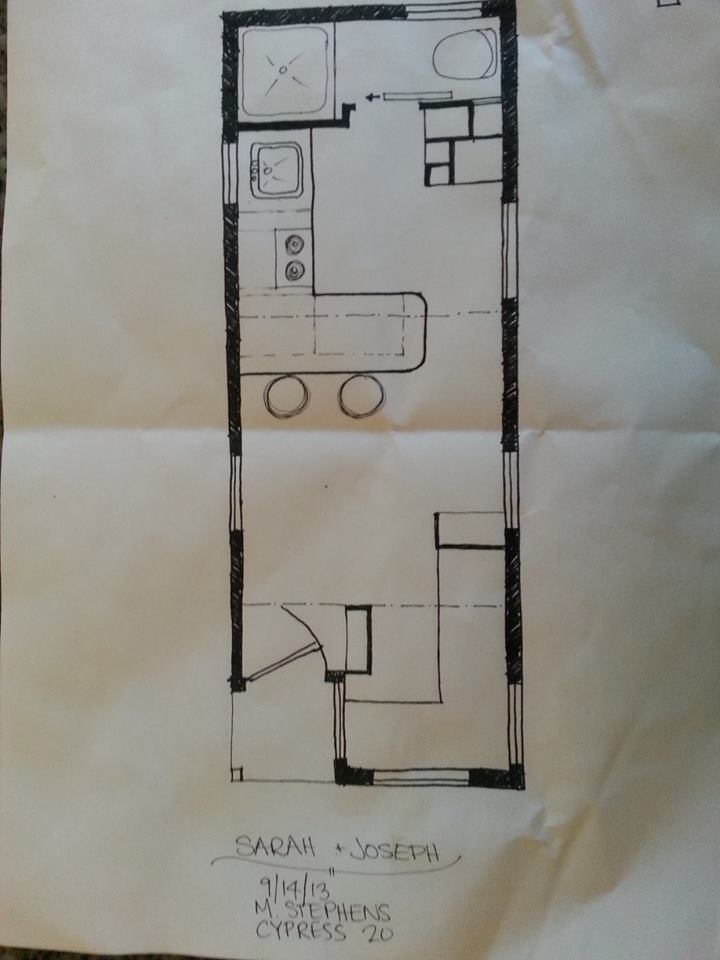
We also met with Meg to hammer out a new vision for the interior of our house. This made the whole thing feel very real all of a sudden. This actually took a few hours, as we walked around on our two-walled trailer platform and visualized various things, drew in our sink and oven and thought thoroughly about who we are and what’s important to us in a space. We asked questions like: How do you enter a space? What’s the first thing you do? the second? How do we want to use the space? Cooking, computer work, yoga, dinner parties, getting dressed, bathing, watching movies, reading, day-dreaming, cuddling (Sarah wrote that last one, I swear).
Also, we’ve been thinking about who each of us are and what we each need. Por ejemplo: Sarah needs private place to write. Joseph wants be able to be an introvert, even within a shared small space. And, we like sitting around the table together. All of this process was really helpful to start thinking about. Sarah and I were just so focused on how to frame a house, that we started letting the inner details fade. Here’s a picture of the sketch Meg made for our interior, though we feel this will be it’s own post when we get a bit closer.
Michaela O’Connor Bono and I met when we were both Zen students at Tassajara Zen Mountain Center the summer of 2006. Michaela was coming right out of post-Katrina New Orleans, and I was just touching down from years of human rights work in Colombia; we bonded immediately and have been friends ever since.
I just returned from ten days in New Orleans working with Michaela, her partner Koji, and their Zen Center. In this interview, I talked with Michaela about their growing Buddhist center, building a community, and how it is to work with your partner on your life project.
Michaela and Koji
Michaela is now a resident priest at Mid City Zen in New Orleans, and has been practicing Zen Buddhism since 2003. After evacuating New Orleans following Hurricane Katrina, she lived and trained at both Tassajara and Green Gulch Farm Zen Centers. Michaela was ordained as a Soto Zen priest in September 2010. Besides leading a Buddhist center, she is active in restorative/transformative justice.
I was in New Orleans to help Mid City Zen set up some systems so they can do their work more easefully. As we worked together to build the structure of their organization I found myself thinking a lot about structure. When I’m at home, our tiny house build feels very tangible to me–it’s about boards and beams, nails and screws. But out in New Orleans, I was able to see the big picture again, and remember that this build is not just about building a house; it’s about building our life together.
While we talked, Michaela made lunch for us (black-eyed pea salad with dill, sautéed kale, grilled cheese) and I sat at the kitchen table taking notes.
Sarah: What are you guys doing here at Mid City Zen in New Orleans?
Michaela: We’re trying to balance religious life with secular life, for our own benefit and the benefit of everybody else we talk to. Right now we’re operating a zendo out of our house, offering daily meditation, classes, and visiting teachers. We’re simultaneously building a temple from the ground up, which will offer more of those things, and a residential life. Having left the cozy, loving, and disciplined monastic Zen practice lifestyle that supported us for many years, we wanted to see if we could take that into New Orleans.
Which aspects did you want to take with you to New Orleans?
The supportive community and the benefits of Zen practice. I wanted to share those things outside of the monastic setting.
What kind of benefits of Zen practice?
Seeing your own thoughts, mind, and heart, and being grounded, And just having a practice.
What does community mean to you? What are the things from your previous experience that you’re trying to bring to life here?
Sharing resources, sharing common goals, supporting one another to have a spiritual practice. It’s really hard for me to achieve anything on my own. So it’s important to find a way to work together and be in harmony with each other so that it supports all of our spiritual practice. That’s why people go to a church or go to a temple. People can have their own spiritual practice but it’s more supportive when it’s in a group with others.
Is supporting spiritual practice the central thing that community does for you?
Community is an alternative to the alienation that a lot of people feel in their daily lives, and to the highly individualized way we sometimes live our lives. It’s about sharing a life together as opposed to everybody living separately and doing things separately.
Any thoughts about community in New Orleans specifically?
Well, it’s been quite an adventure to try to promote discipline in this city. There are so many more fun things to do than sit still. But I think people really appreciate taking a break from the chaos to check in with themselves and to meet other people who are interested in meditation. I had always had the dream of having a zendo here but doing it with a partner is amazing. I can’t imagine doing it on my own.
Tell me more about working with your partner.
Even right now, Koji just went away for three weeks and I notice the difference; it’s so much easier to share the responsibility. Also there’s that same thing about not being able to do things on your own, being in a relationship is like a mini-community within a community.
Can you put into words how it’s different to do something like this with your partner rather than with someone else?
There’s two aspects of it–what’s it like to be in a relationship when you have a shared goal versus when you don’t? And–what’s it like to work on a project with your partner as opposed to with not-your-partner.
Yeah, I am really interested in both of those aspects.
What’s it like to be in a relationship and have a shared goal? I don’t want to sound negative but it’s really hard. You have to figure out a way to work with each other and not let your relationship dynamics get too much in the way. On the other side, knowing each other’s dynamics so thoroughly can actually help your working relationship. Everything that’s a challenge about being in a relationship and working together is also a benefit. The things you know about your partner, how you’ve communicated in your relationship, can help you communicate about the project you’re working on. You are always learning how to communicate–communication is the biggest thing, in the relationship or the project, at least for us.
It’s tricky when you ask someone to do something for the project, you have to be aware, you have to check, “Why am I asking them to do that and how am I asking?” You need a lot more awareness. And, it’s a real joy to have a partnership where you have a shared goal. A lot of couples come to that point of, “Are we compatible? Do we have a shared idea of what our life is supposed to be like?” Some people answer that with having children or living in a certain place or a job. For us it’s really amazing because it’s a shared spiritual path, it’s a shared location path, and it’s a shared existential path: why we do what we do.
That is really great.
Of course we have discussions about the details of what that will look like but we don’t have to spend too much time wondering what’s the most important thing.
Or negotiating what the thing is.
Right. We have this really solid amazing tradition that’s been handed down to us for thousands of years, and we can rely on that and trust that, and we also have to make it our own. And I think we’re doing that in our relationship as well. We have a shared understanding of how to treat each other, how we can study ourselves and take responsibility for our own minds and hearts, and take care of each other. That understanding comes directly from our tradition and our practice. And we have to make that our own too, “What does that look like?” But we have a solid, ancient support system.
I feel that in my relationship too.
It’s amazing. I can’t imagine it any other way. And a side note, I have this constant faith and trust that my partner is always working on what they need to be working on, in the personal, internal… that they’re always going to be self-reflecting and taking responsibility. I don’t ever question that, which is very different than in other kinds of relationships I’ve been in.
We had that conversation the other day about how you and Koji are building a Zen temple and Joseph and I are building a tiny house and they seem very different, but there is actually this similarity. We are each doing what is true to us, somehow our paths are sprouting from the same place.
It’s setting up a place from which we’ll do the work in the world that we need to do. It offers us an unconventional alternative to the conventional options. You can use the tiny house in many ways, especially since you’re building it off the grid. You can take it to where you want to go which is important to how you want to live. And for us we want to live sharing our lives with a larger community, with more people, so we have to set up the space we can do that.
I think what I’m trying to get at also is how we are each responding to our different causes and conditions. And the response looks different because the conditions are different, but we are actually doing the same thing, which is to find what is truest and deepest, what is at the root, and to try to prioritize that. And for you that is being in New Orleans, living with other people, and sharing a Zen practice together. And for us that looks like financial freedom which allows for creative life, mobility for now, and also having a home. So those responses look different, but for each us they are the true root response to our conditions. It sounds obvious now that I said it, but I actually just realized the similarity being here with you. I had thought we were doing very different things.
Yes.
If you want to learn more about Michaela and Koji’s project, please visit: midcityzennola.blogspot.com. Their website is in development, so check back often for updates.








 Seeds with Wings
You must be logged in to post a comment.