All posts by seedswithwings

Unknown's avatar

About seedswithwings

We are building a tiny house on wheels in Sonoma, CA.

And the Drums Play On. Part I

I sold my drum set today.  It now sits tuned and disassembled in the trunk of an Outback.wpid-20130826_081011.jpg
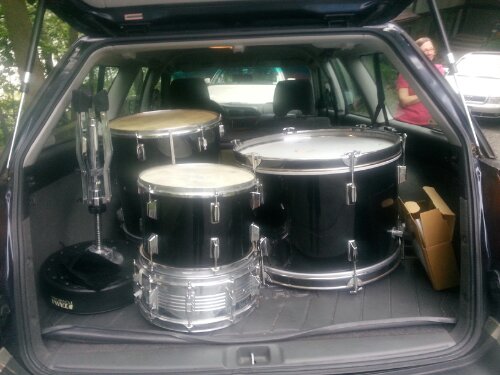
Selling this drum set was hard for me.  Not because nobody wanted it, but because I didn’t want to let it go!  Why IS that!?  I haven’t played it professionally since 2005, and it’s been sitting un-tuned and un-played since then.  I told myself it’s just an object when in reality it meant much more than that.

When I was 9, I started playing basic rock rhythms but as I matured I needed to figure out how to make new, complex sounds to reflect the world around me.  Not only are drums interactive instruments in how you tune and play them, but as you explore different tuning, pitch diversity and sound quality, you begin to think in unexpected ways, too. The world around me became an interactive sound playground (to the chagrin of many) that could be adjusted and tailored to what I was trying to express.

This tailoring also relied on a mechanical exploration of objects.  What does that log sound like if I hit it with my hiking stick and how can I cut/notch/sand it to make a different sound?  How about an old oil drum or some PVC pipe? My drum teacher kept sticks in his car at all times, and revealed to me that his dashboard had excellent rebound and was a very lively (and quiet) surface to practice on.  

This is the essence of improvisation.  Looking at something which has a clear purpose, and changing the perception of it to suit a different purpose.  Another example of this is my metal mixing bowl. At first glance it’s just that, but take a closer look and you can see tiny dents and a few holes drilled into it with a U-joint attached to use on my hi-hat stand.

wpid-20130825_203347.jpgWhat a sound!  a sharp THWONG followed by a melodious ringing. It has so many musical applications that it became a mainstay of the kit.  

This flexible perception of usefulness has carried over into many aspects of my life.  It has built a comfort-zone in the tricky landscape of money, work and love.  Knowing everything has other uses and isn’t always what I think has lead to a great deal of surprise, delight and oddly dented pots and pans. 😉  It has supported me in tailoring traditional uses of things like bicycles, Christmas trees and house-building to my own style in new contexts.

Reflecting on why they were so hard to part with, I came to understand the drums had been a medium with which to explore the world.  A journey wrapped in dogwood and synthetic skins that expanded my perception of what’s possible!  They taught me things that can only be taught quietly; secretly; in the moments just before you realize what you’ve stumbled upon.  Making something out of nothing, then turning it into something else is just the tip of the iceberg.  This kit lead me gently through my young life, and  whispered tales of patience, persistence and humility; all of which I’m still growing into;  but that is another story, and shall be told another time.

The Discomfort and the Freedom of Not Knowing

The hot Sonoma sun beat down on our shiny black trailer, our sunhats, and our neatly placed two-by-fours.  Those 2X4s had not come easy.  2X4s (as I learned only recently) are used to make studs, which are like the bones of the house.  The first part of framing the walls is cutting the 2X4s to the right size and nailing them together.  We’d spent most of the previous day working with the building plans to accommodate our salvaged windows and our trailer, which seemed to be slightly narrower than the one in the plans.  I can’t imagine how it took us so long to adjust the plans for that first wall, but I’ll just say I haven’t seen so many fractions since the third grade, and there are many hidden dimensions, overlaps, and extra spaces that need to be accounted for.

Nicola, our architect friend, stopped by to say hi.  I asked him about one of our assumptions–that our trailer was two inches narrower than the trailer in the plans.

“No….” he said, “The wall extends for an inch beyond the trailer on both sides.”  And he went on to show us how the wall in the plans was designed to be wider than the trailer.

“Okay,” I said, trying to sound cheerful and resilient and ready to start all over again.  When Nicola left we set the 2X4s aside and took a long lunch break. We barely spoke except to say, “disheartened… demoralized… disappointed.”

Joseph muttered, “Of course, I should have known.”

I sat with my complete unknowing, wondering, “What makes me think I can do this thing that professionals do?”

It is so uncomfortable to know so little, to work so hard to try to understand and then to fail and have nothing to show for all that work.  It’s hard enough in general to not fall victim to imposter syndrome (when people, especially women, underestimate their own expertise), and now I’ve taken on a project where I really don’t know anything.  I don’t even know what some of these tools are called!  The challenge is to withstand the uncomfortable feeling of incompetence.  There are lots of things I am good at, and wouldn’t be more comfortable to just do those?

Seth Godin says, “Learn something new for no apparent reason,” as part of his artist’s path.  As we get older we are less and less comfortable with starting at the beginning. We feel we are too old to be true beginners.  We feel silly.  Like when you are learning a language and meet young native-speaking children,

“That four-year-old speaks better Spanish than I do!  With a perfect accent!”  In fact, she speaks better Spanish than I ever will.

The challenge is to immerse myself completely in this learning, even not seeing how it connects to what I’ll do once this project is over.  I need to learn as much as I can so I can do this project right now, whether or not I ever do it again.  This can be frustrating and demoralizing… but maybe it can also be a kind of freedom, a kind of bemused awe at the myriad things I’m not an expert in, but can now appreciate the depth of skill of someone who is.

It’s even a bit of a relief to know nothing.  I am just a person who never learned to build and is now, for some reason, trying to do so, stumbling along putting together a durable, square, impermeable house.  If I mess it up it doesn’t say anything about my value as a person.  My ego has nowhere to stand.  Occasionally she gets a bit of a toehold,

“Aha, I’m actually not bad at measuring and cutting 2X4s on the chop saw.”  But then they don’t fit!  What happened?

All this humility is uncomfortable, exhausting, and… good practice.   After our lunch break we started again–back to modifying the plans, measuring, cutting.  We finished our first framed wall the following afternoon.  We can do it, but slowly, slowly.

When you’ve started something as an adult and a true beginner, how was that for you?  Did you enjoy the freedom to fail?  Or were you frustrated by not being able to do what others did so easily?  Or some combination?

wpid-20130728_093331.jpg
2X4s, properly measured, cut, and arranged, at last

A Strong Foundation, and a Wall

by Joseph and Sarah

It’s been an eventful month here at our group build site in Sonoma.  As a group, we’ve been building subfloors onto our trailers and starting to frame our walls.   Here’s a little update we wrote for the Tumbleweed Tiny House newsletter, and we added a bonus here:  a short video of our build progress!  Check it out at the end of this post.

I’m sure we’ll get used to it one day, but for now Joseph and I often find ourselves thinking, “This is actually happening! This is our house!”  There is something so special about knowing exactly what is going into every single part of this house–every self-tapping metal screw, piece of plywood, and batt of insulation.

We started by protecting our future houses by screwing pressure-treated 2X6s all around trailer’s outer edge.  It’s not easy to screw through pressure-treated lumber or steel trailers, let alone both.  But we got much better at it as we went around each trailer, eventually settling into the right balance between effort and gentleness to get the screws all the way in without breaking.

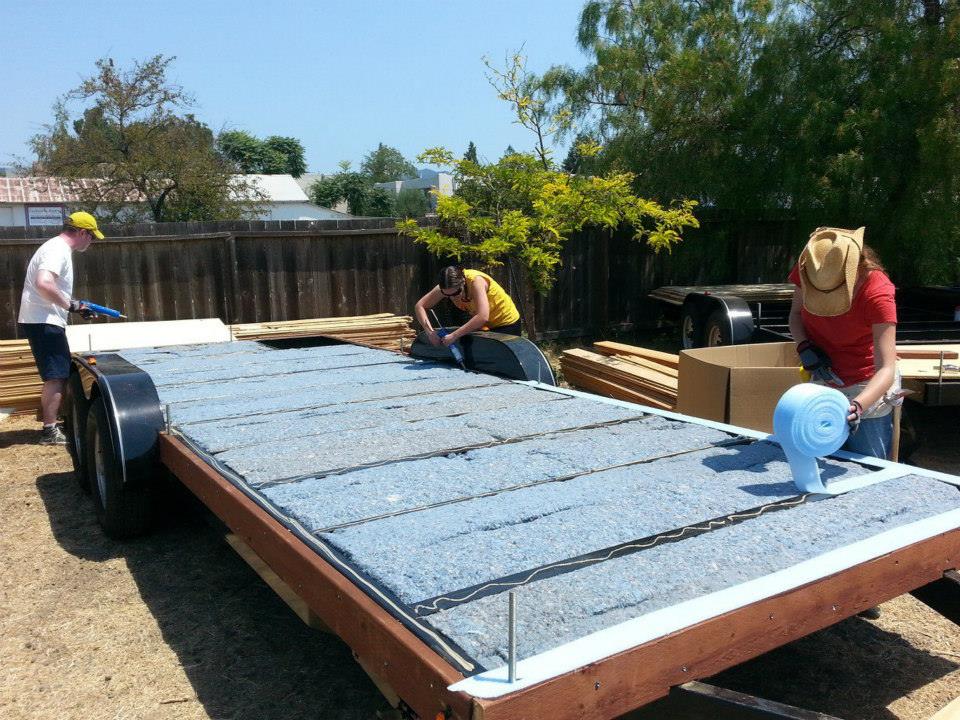
Next we put in the subfloors.  Meg and Dan (Team Yellow) and Joe and Breanna (Team Purple) used polystyrene insulation that they cut to fit between their trailer struts.  After Team Red’s (that’s us) woeful experiment with washing wool for insulation we bought batts of recycled denim and fit those in.  We put down construction adhesive, sill sealer, then we attached ¾” plywood.  Yahoo–we have subfloors!

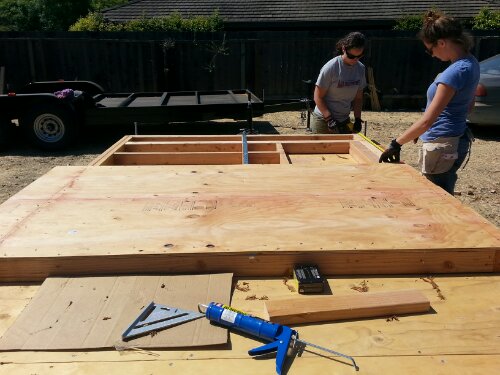
We are doing a traditional “stick build,” so we got going on modifying our plans to fit our salvaged windows, and then cutting sill plates for the whole house.  We then cut the studs for the back wall and nailed them together with our new serious, dangerous tool, a pneumatic nail gun.  Ka-thunk!  We now have a back wall.

Sharing tools, batteries, and hands was such a benefit in this physical process.  Lifting ¾” ply is not easy by yourself, nevermind placing the tongue in the groove and getting it all screwed down.  When we made a mistake on our house, it was satisfying to be able to talk about what happened, and prevent our co-builders from doing the same thing.

The other two couples are building with SIPS (structural insulated panels), which have not yet arrived.  In the meantime, Joe and Bre are researching old-time-y locks with skeleton keys for their front door.  They’re also shopping around for a speak-easy door hatch.

Coming up next, a good old-fashioned SIPS-raising.  Also, torching exterior siding shou-sugi-ban-style (What? You’ll see!) And more walls from us, definitely.

If you’re on Facebook, please check out our Seeds with Wings page – we are trying to post photo updates pretty often.  And below is our fascinating yet concise build update video and pictures.  You can see our first wall!

1000195_328997830568085_505293537_n1006289_328997780568090_2100437628_nwpid-20130728_100906.jpgwpid-20130727_163508.jpgwpid-20130728_110154.jpg